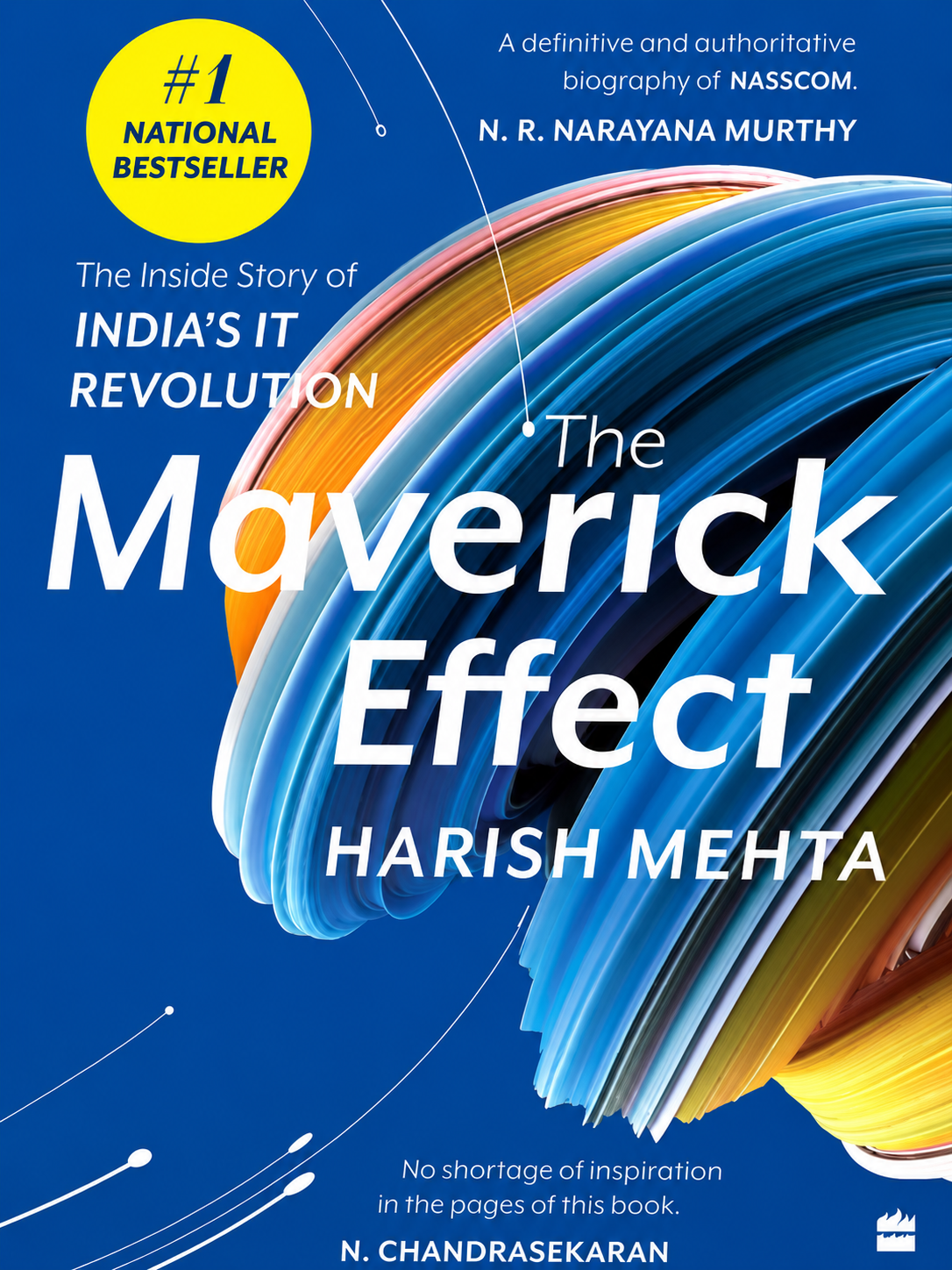
DEWANG MEHTA FOUNDATION TRUST, GUJARAT TECHNOLOGICAL UNIVERSITY & HARISH MEHTA, AUTHOR-THE MAVERICK EFFECT

Accredited with
A+ grade by NAAC




SYNOPSIS
The Maverick Effect AI Challenge, jointly organized by Gujarat Technological University, the Dewang Mehta Foundation Trust and Harish Mehta, aims to spark the next generation of innovation in the field of Artificial Intelligence.
Thirty odd years ago, a small group of Indians set out to build India’s IT industry. With little capital and no blueprint to follow, what carried these entrepreneurs forward was a willingness to solve hard problems together. That spirit became the Maverick Effect, and it transformed the Indian IT sector and, through it, India.
NASSCOM was where that spirit took shape. Its frugal, inventive, problemsolving approach carried the Maverick Effect well beyond the IT industry, helping create jobs, opening up social mobility, and putting affordable internet within reach of ordinary people. What began as an industry story ended up enhancing opportunities for millions of Indians.
The Maverick Effect AI Challenge hands the next move to you.
Artificial intelligence is the frontier your generation gets to shape. This challenge asks students and teams to take on real-world problems with AI solutions that show ingenuity, technical prowess, and genuine societal impact. We are looking for how you can tackle a real problem that someone in India is living with right now. A farmer watching a crop fail. A patient who cannot reach a doctor in time. Or an unsuspecting person being talked out of their savings on a scam call.
Pick one of the nine problem statements. Build something honest and useful that could matter beyond the screen it runs on. Show us how you can contribute to a future where India’s global perception as a tech-leader stands enhanced with the prowess of AI.
OBJECTIVE
The Maverick Effect AI Challenge is designed to inspire and empower engineering students in Gujarat to explore the field of Artificial Intelligence (AI) through hands-on problem-solving and innovative thinking.
CRITERIA
To participate in the Maverick Effect AI Challenge, the following criteria must be met:
Eligibility
- There are no registration or participation fees.
- Students from AICTE/UGC-approved colleges, institutes, or universities in Gujarat are eligible to participate.
- A student may be from any part of India or abroad, provided they are currently enrolled in a college located in Gujarat.
- The challenge is not limited to engineering students; students from other academic disciplines are also welcome.
Participation Rules
- Participation can be individual or team-based.
- From the 9 available problem statements, a student or team may participate in only one category.
- A team can have a maximum of 5 members.
- A student may participate in only one project, either as a team leader or a team member.
Submission Requirements
- Participants must complete all processes and procedures specified on the official website to submit their nominations.
Restrictions
- Colleges, universities, private organizations, associations, individual professionals, or groups of professionals are not eligible to participate.
- This challenge is exclusively intended for students.
CHALLENGE FORMAT
Step 1 Announcement
Announcement of 9 problem statements through a website.
Step 2 Submission
Online submission of responses by participating students.
Step 3 Evaluation
Evaluation by a panel of jury members to shortlist the best projects.
Step 4 Mentoring
Short-listed students/teams will be invited for a mentoring and presentation session at Ahmedabad on 13th August 2026.
Step 5 Final Result
The final result will be announced on 14th August 2026 at Ahmedabad.
Step 6 Logistics
Details for the mentoring session and presentation will be shared with the short-listed students, including the facility for their stay and food.
SCHEDULE
Submission Deadline Online
Online submission of responses by participating students and teams.
Announcement of Short-Listed Teams Online
Mentoring Session & Project Presentation Person
Ahmedabad
Award Announcement Person
Ahmedabad
* Subject to confirmation
EVALUATION CRITERIA
Relevance
How well does the solution address the specific problem statement provided?
Innovation
Originality and innovative approaches implemented in solving the challenge.
Technical Accuracy
Correctness and technical effectiveness of the AI/ML techniques utilized.
Implementation
Code quality, overall usability, and operational efficiency of the solution.
Scalability
Scalability of the model and its potential real-world societal impact.
Presentation
Clarity, structure, and effectiveness of the documentation and project pitch.
PRIZES & REWARDS
Winner
Prize Amount & Trophy
1st Runner's Up
Prize Amount & Trophy
2nd Runner's Up
Prize Amount & Trophy
Additional Opportunities
- Lunch/Dinner with Shri Harish Mehta and Dignitaries from the Government, Academia and Industry Experts.
- Awards, trophies, and participation certificates.
- Letter to shortlisted teams/students for incubation and venture support from GTU Innovation Council.
Problem statements designed for real India
Each problem is built around a societal need where AI can create practical, ethical and scalable impact.
Agriculture: Crop Disease Diagnostician
Build an offline edge-AI or mobile solution to identify early-stage crop diseases from smartphone photos and recommend localized organic treatments.
Healthcare: Low-cost Rural Triage
Create an AI assistant for low-bandwidth clinics that processes basic vitals and symptom queries in regional languages to flag high-risk cases.
Education: Adaptive Vernacular Learning
Translate and personalize STEM learning into interactive micro-modules that adjust to student learning gaps in real time.
Sustainability: MSME Energy Optimizer
Design an IoT-to-AI energy auditing framework that predicts wastage, prevents equipment failures and improves energy efficiency.
Smart Cities: Traffic & Emission Reduction
Develop predictive traffic optimization using CCTV feeds, dynamic signal timing and alternate routing to reduce congestion and emissions.
Financial Safety for Rural India
Help first-time digital banking users detect scam calls, fake UPI requests, phishing and loan scams in local languages.
Water Intelligence Platform
Predict water shortages, leakages and groundwater depletion using weather, consumption, reservoir and sensor data.
Waste Segregation & Circular Economy
Create a computer vision system to identify waste, classify categories and recommend nearby collection or recycling points.
Cybersecurity Threat Detection
Build actionable threat detection for critical digital infrastructure with phishing classification, anomaly detection and guided response playbooks.